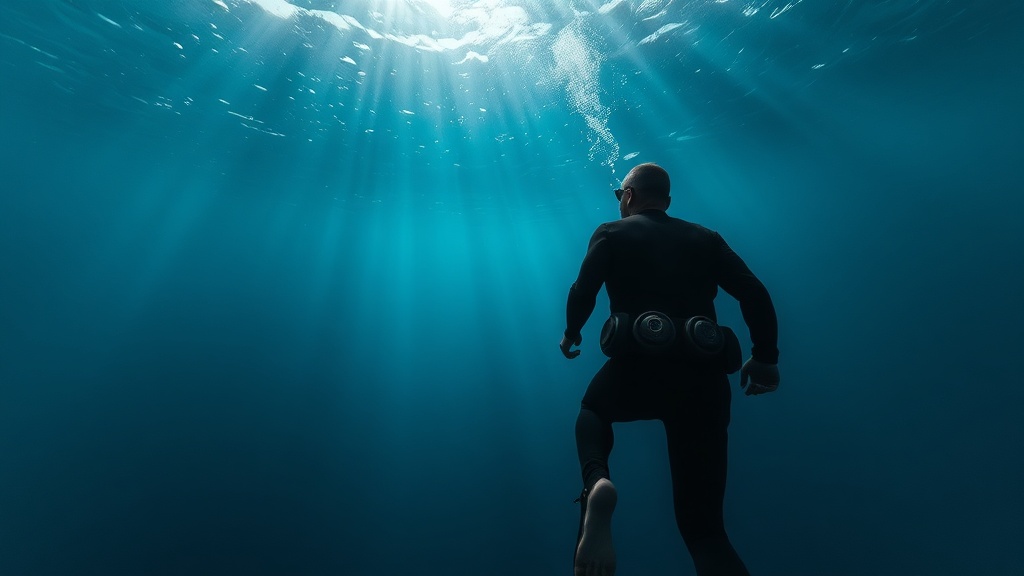
You're Over-Weighted. I Can Tell from the Surface.

You're over-weighted. I can tell from the surface.
Before you surface-kick toward the line, before you duck under, before your first equalization — I can already see it. The way you float too high. The way you kick three extra times on the descent before the water finally takes you. The way you're working against yourself from the moment your face hits the water.
In my experience teaching and running safety, over-weighting is the single most common technical error I see. Not because divers are lazy or careless. Because nobody taught them the math, and the rental shop just handed them a weight belt and said "that should do it."
It won't do it. Not correctly.
Why This Matters More Than You Think
Weighting isn't just a comfort issue. It's a safety issue.
When you're over-weighted, two things happen that work against you simultaneously:
On the descent, you're fighting the lead. Your wetsuit is buoyant near the surface — neoprene traps air, and at 0–10 meters you're genuinely positive. If you're carrying too much weight, you either exhaust yourself kicking down through those first ten meters, or you get pulled under faster than your equalization can keep up. Neither is great.
On the ascent, the math flips. Your wetsuit compresses under pressure — neoprene loses buoyancy progressively as depth increases, and the deeper you go, the less lift your suit provides. If you're carrying weight that was sized to overcome your surface buoyancy, you may find the ascent genuinely effortful when your suit has compressed and your lungs have shrunk to a fraction of their surface volume. You're ascending under your own power when the water should be helping.
The standard across freediving agencies is that a correctly weighted diver should be neutrally buoyant at 10 meters. At the surface, you float. At 10 meters, you hover. Below that, the water takes you.
That 10-meter neutral is the target. Most people have never actually checked theirs.
The Weight Check You Should Have Done Before Your First Open Water Session
Here's the protocol. It's simple. It requires a buddy — everything does — and about 15 minutes of honest testing.
Step 1: Put on your full dive kit. Wetsuit, mask, fins, weight belt. Fill your lungs to the capacity you'd use for a normal dive breath — not a max inhale, not a tidal breath. Your actual dive breath.
Step 2: Float at the surface without kicking. Note where your eyes are relative to the waterline. If your eyes are significantly above water, you're positive. This is expected.
Step 3: Now go to 10 meters — either with a line or with your buddy watching from the surface. Exhale slowly until you're at a comfortable, mid-breath lung volume. Not a full exhale. Not packed lungs. Mid-volume. Stop kicking. Note whether you rise, sink, or hover.
If you rise: you need more weight.
If you sink: you need less.
If you hover for a few seconds before the compression starts pulling you down: you're close.
Do this honestly. The number that comes up often surprises people.
The Wetsuit Variable Nobody Talks About Enough
Your weight check is only valid for that specific wetsuit.
A 3mm tropical suit at 30°C bathwater behaves nothing like a 5mm suit in 18°C Canary Islands thermocline. The neoprene cell structure, the suit's age, whether it's open-cell or closed-cell — all of it changes your surface buoyancy and how aggressively the suit compresses with depth.
Open-cell wetsuits (the kind most serious freedivers use) are cut from a different foam than the closed-cell suits rental shops carry. Open-cell foam has a more porous cell structure, and the suit is worn with a thin water layer between the neoprene and your skin rather than a fabric lining — a different density profile that changes how the suit behaves under pressure. If you've been weighting yourself in a rental closed-cell suit and you finally buy your first open-cell, run the weight check again. Don't assume the old setup transfers.
This is one of the reasons I'm skeptical of rental gear weight recommendations. The shop doesn't know your body composition, doesn't know how the suit fits your specific frame, and often doesn't ask. They hand you what worked for the last person. That's not the same as what works for you.
There's also the salt variable. If you train in a pool and you're running your weight check in fresh water, pay attention: salt water is denser. You'll float higher in the ocean than in a pool, which means the weight that made you neutral at 10 meters in fresh water may leave you more buoyant in the sea — requiring a small correction upward. Run the check in the actual conditions you're going to dive.
What Over-Weighting Does to Your Dive Profile
Here's what the physics look like when you're carrying too much:
The duck dive costs you more energy. You're kicking against positive buoyancy to get negative at the surface, then suddenly going very negative when the suit compresses at 8–10 meters. That transition is abrupt. You're not gliding into your freefall; you're falling.
Your freefall starts late and is inconsistent. The whole point of passive descent — the reason the black line is beautiful — is that you stop kicking, and the water does the work. If you're over-weighted, you never quite achieve that effortless suspension. There's always a jerkiness to the transition.
Your ascent is harder. This is the one that matters most. At 25–30 meters, you're working upward through water with a compressed suit and lungs that are a fraction of their surface volume. Your body wants to rise — but the lead is telling it not to. You're burning oxygen on the ascent when you should be conserving it. Every extra kilo is a tax.
The worst case: The over-weighted diver who also has a strong duck dive can get very deep very fast, and then find the ascent genuinely laborious. If your PO₂ is already marginal, working hard on the ascent is exactly when you don't want to find out you're over-weighted. Understanding shallow water blackout mechanics and proper buddy protocols is what keeps you alive when the margin shrinks.
The Common Counter-Argument (And Why It's Wrong)
"But I like having more weight. It makes the descent easier."
I hear this from students every time. Here's what's actually happening: the extra weight is solving a problem you created. The descent feels easier because you're compensating for improper duck dive technique. If you can get to 10 meters cleanly and your buoyancy is correct, the water takes over. You don't need to fight it.
Extra weight on the descent also means extra work on the ascent. The physics don't care about your preference. You're borrowing ease on the way down and paying it back — with interest — on the way up.
Get the technique right. Dial the weight correctly. Proper equalization mechanics and controlled descent work together. They solve each other.
A Note on Weight Distribution
Where you carry the weight matters almost as much as how much you carry.
A weight belt sitting on your hips shifts your center of gravity back. You'll have a tendency to come through the water at a slight angle — hips low, head high — which creates drag and disrupts your streamline. Some freedivers address this by moving weight to the chest with a weight vest, or using a neck weight for pool diving, to keep the body horizontal.
If you've ever watched a good freediver descend, the thing that looks effortless isn't just the kick — it's the line. Head to toe, perfectly vertical, no hunting for position. A lot of that is proper weight distribution working with the body rather than against it.
If you're weight belt-only and you've never experimented with placement, try sliding it higher on your torso, closer to your center. Notice if your horizontal position improves. Small adjustments make a real difference at depth.
The Recheck You Should Do Every Trip
Not just every trip — every conditions change.
Different site. Different wetsuit. Different water temperature. Run the check.
It takes fifteen minutes. You'll dive better for the entire rest of the trip. And you'll surface from every dive with more oxygen left than the diver next to you who never bothered.
That's the margin. That's what you're optimizing for.
Weighting is one of those things that seems like admin — a box you checked once in your open water course — and then never revisit. But it's actually one of the most direct levers on your efficiency, your safety, and the quality of your freefall.
Get it right. Recheck it. And if someone at the rental counter just hands you a weight belt without asking a single question about your suit, your depth, or your target buoyancy window...
...ask the questions yourself.
Breathe easy, dive safe.