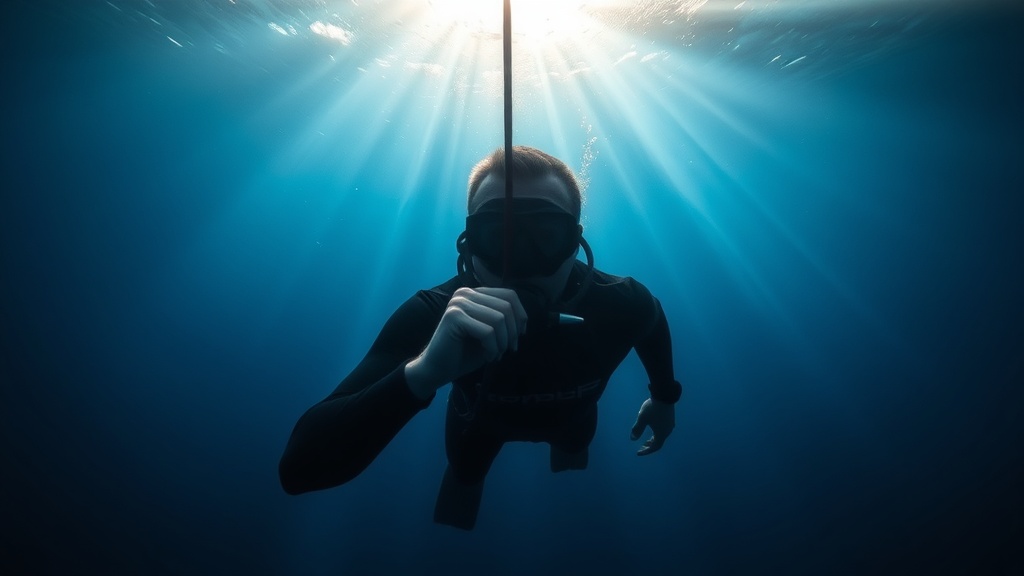
Your Ears Are Lying to You: A Frenzel Equalization Primer for the Plateau-Stuck Diver
Your Ears Are Lying to You: A Frenzel Equalization Primer for the Plateau-Stuck Diver
The wall at 15 meters is not a depth problem
Every month someone messages me the same thing: "Koa, I can get to 12-15 meters but then my ears just won't clear." They assume they need more flexibility, or better fins, or some secret supplement. They don't. They need to stop blowing their lungs into their skull.
That sounds harsh. I mean it with love. But Valsalva — that grunt-and-force technique you learned in a pool somewhere — is actively working against you past a certain depth. And the longer you rely on it, the harder the switch to Frenzel becomes, because your body has spent months reinforcing a motor pattern that freediving does not want.
Why Valsalva fails you (and it's not your fault)
Valsalva equalization works by pressurizing your entire thoracic cavity and hoping some of that pressure leaks through the Eustachian tubes. It uses your breathing muscles — diaphragm, intercostals, the same machinery responsible for keeping you alive on a breath hold.
Problem one: you're burning oxygen to equalize. Every Valsalva attempt is a mini exertion event. At 10 meters, you can get away with it. At 20, you're spending metabolic currency you cannot afford.
Problem two: as ambient pressure increases with depth, your lungs compress. The air supply you're drawing from gets smaller. Valsalva needs volume. By 15-20 meters, there's not enough thoracic pressure left to push air through those narrow tubes, and you hit a wall that willpower cannot break through.
Problem three — the one nobody talks about — Valsalva creates tension. In your neck, your jaw, your chest. Tension is the opposite of what we want on a dive. Tension accelerates CO₂ buildup and makes the Mammalian Dive Reflex work against you instead of for you.
Frenzel in plain language
Frenzel equalization isolates the problem. Instead of pressurizing your whole chest cavity, you close your glottis (the valve at the back of your throat — you use it every time you hold your breath or say "uh-oh") and use your tongue as a piston.
That's it. Your tongue pushes a small pocket of air upward through the Eustachian tubes. Your lungs stay out of the conversation entirely. No exertion. No tension. No burning through your oxygen budget to clear your ears.
I teach it in three steps. These are dry-land steps. Do not attempt new equalization techniques in the water until you own them on the couch.
Step 1: Find your glottis lock
Fill your cheeks with air. Now close the back of your throat so the air stays trapped in your mouth — your chest should not be involved. If you can puff your cheeks out like a trumpet player and hold that air without any chest engagement, you've found the lock. Practice holding it for 10 seconds at a time. This is the foundation of everything.
Step 2: The tongue piston
With your glottis locked and cheeks full of air, press the back of your tongue upward — like you're making a hard "K" or "G" sound. You should feel pressure in your ears. That's the piston. The back of the tongue rises, compresses the air pocket, and the only place it can go is through the Eustachian tubes.
Play with this. Say "kuh-kuh-kuh" silently with your glottis locked. Each "kuh" should produce a small pressure change in your ears. When you can do 10 in a row without losing the lock, you're ready for step three.
Step 3: Pinch and equalize
Same setup — glottis locked, air in mouth. Pinch your nose. Now do your tongue piston. You should hear and feel your ears clear, the same sensation as yawning on an airplane but deliberate and controlled.
If nothing happens, check two things. First, is your glottis actually locked? If air is leaking into or out of your chest, the system fails. Second, are you using the back of the tongue or the front? The front does nothing here. It's the root of the tongue, the part you never think about, that does the work.
The training protocol I actually use
Dry Frenzel practice: 5 minutes, twice a day. Morning and evening. I sit in the van with the windows down — Kona air coming through — and I do sets of 20 tongue-piston reps with the glottis locked. No nose pinch for the first set (just feeling the mechanism), nose pinch for the second set (confirming the equalization).
I've been diving for years and I still do this. It's not a beginner exercise. It's maintenance, the same way a guitarist still practices scales. The motor pattern needs to stay sharp because at 40 meters with a contracting diaphragm and rising CO₂, you do not have the cognitive bandwidth to troubleshoot technique. It has to be automatic.
After two weeks of dry practice, take it to shallow water. Feet-first descents on a line, equalizing every meter. Not every two meters. Every single meter. Over-equalize. Make it boring. The goal is not depth — the goal is making Frenzel so reflexive that you forget you're doing it.
The thing I wish someone had told me
When I was transitioning from Valsalva to Frenzel, I lost depth. I went from comfortable at 20 meters back to struggling at 12. It felt like regression. It felt like the technique was making me worse.
It was not. I was rebuilding from the foundation, and the old motor pattern kept hijacking my attempts. My body wanted to blow from the chest because that's what it knew. Every dive was a fight between the new pattern and the old one.
It took me about three weeks of disciplined, ego-free practice before Frenzel became my default. Three weeks of shallow dives while my training partners went deep. Three weeks of swallowing my pride and working at 8 meters like it was my first time on a line.
And then it clicked. Not gradually — suddenly. One morning off Honokōhau Harbor, I dropped to 25 meters and realized I had equalized six times on the way down without thinking about it. No tension in my neck. No pressure in my chest. Just the tongue doing its job while the rest of me stayed quiet.
That is the Frenzel moment. When equalization stops being a task and becomes background noise. When the mechanical problem disappears and all that's left is the descent.
Beyond Frenzel: when to think about Mouthfill
Frenzel will take most recreational freedivers past 30 meters comfortably. But if you're pushing toward 40+ and competition depths, there's another technique waiting — Mouthfill, which is essentially pre-loading your mouth with air at a shallower depth and using that stored charge to equalize deeper, where even Frenzel runs out of accessible air.
I'm not going to teach Mouthfill in a blog post. It requires hands-on coaching, and bad Mouthfill technique can cause barotrauma faster than bad Valsalva. But know that it exists, and that solid Frenzel is the prerequisite. You cannot skip the step you're on.
The real lesson
Equalization is the most mechanical part of freediving, and that's exactly why people get stuck on it. We want the dive to be spiritual, meditative, flow-state. We don't want to think about tongue placement and glottal locks. But the mechanical work is what earns you the stillness. You put in the reps on the couch so that in the water, the body handles the plumbing while the mind goes quiet.
Your ears aren't the problem. Your technique is. And technique is fixable — usually in weeks, not months. Stop forcing. Start isolating. And practice on dry land before you ever put your face in the water.
Breathe easy, dive safe.
— Koa