Why You Should Spend a Night in a Desert Camp Under the Stars
The Unmatched Clarity of the Night Sky
The Healing Power of Absolute Silence
A Deeper Connection to the Natural World
Many travelers assume that true silence is found in the deep ocean or high in the mountains, but they often overlook the profound auditory void of the high desert. A common misconception is that desert camping is merely an exercise in endurance against heat and thirst; in reality, it is a deliberate practice in sensory recalibration. This post outlines the physiological and psychological benefits of spending a night under a desert sky, focusing on how the unique environmental stressors of the desert—extreme temperature shifts, absolute darkness, and low humidity—can facilitate a deeper state of mental stillness.
The physiological benefits of thermal regulation in the desert
The desert environment operates on a radical thermal swing. During the day, the sun provides intense radiant heat, but as soon as the sun dips below the horizon, the lack of humidity allows heat to escape the atmosphere rapidly. This rapid cooling is not just a weather pattern; it is a tool for resetting your circadian rhythm. When your body moves through these significant temperature shifts, it forces a heightened awareness of your internal homeostasis.
To manage this effectively, you must approach your gear with technical precision. Do not rely on a single layer. Use a high-quality sleeping bag with a temperature rating at least 10 degrees lower than the expected nighttime low. For example, if the desert night is expected to hit 45°F (7°C), a bag rated for 35°F (2°C) provides a necessary safety margin. Layering with a synthetic or merino wool base layer, such as those produced by Smartwool or Icebreaker, allows you to manage moisture and heat retention as your body temperature fluctuates through the night.
This process of thermal adaptation mirrors the way we train the body to handle pressure changes in freediving. Just as the body learns to manage oxygen efficiency under depth, the desert teaches the body to manage energy expenditure through temperature regulation. This physical engagement with the environment prevents the mental lethargy that often accompanies climate-controlled travel.
The impact of absolute darkness on visual recovery
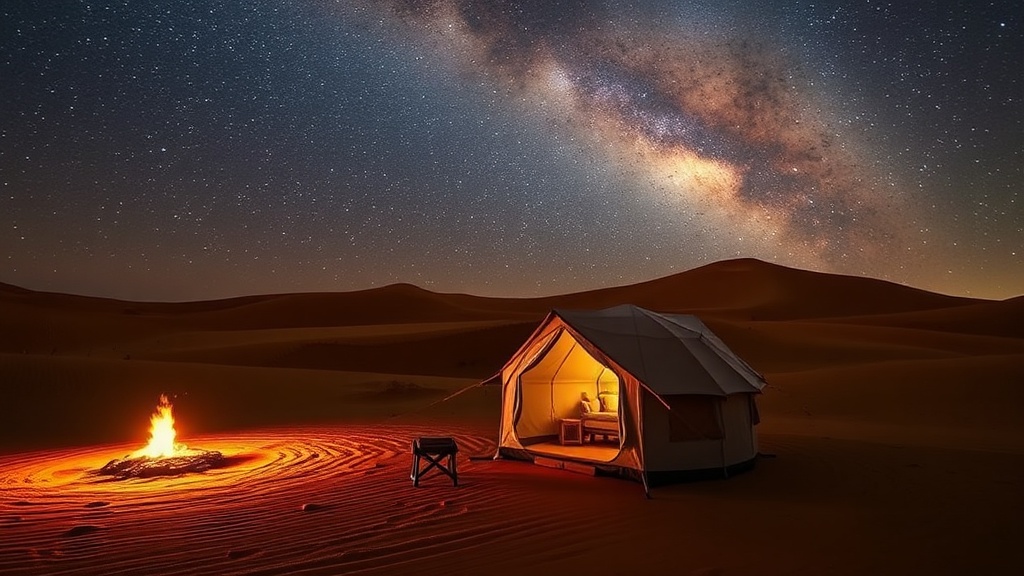
Modern life is characterized by constant light pollution and the blue light of digital screens. In the desert, particularly in areas like the Joshua Tree National Park in California or the Mojave Desert, the darkness is nearly absolute. This absence of light is critical for the production of melatonin and the full recovery of the visual system.
When you spend a night in a desert camp, you are practicing a form of visual fasting. Without the stimulus of artificial light, your pupils dilate to their maximum capacity, and your brain begins to process subtle light sources—the Milky Way, planetary movement, and even the faint glow of the zodiac. This level of visual immersion requires a different kind of focus than the rapid-fire scanning required in urban environments.
To maximize this benefit, limit your use of artificial light to essential tasks. Use a headlamp with a red-light mode, such as the Petzl Actik Core. Red light has a longer wavelength and is less likely to disrupt your night vision or suppress melatonin production. By training your eyes to operate in low-light conditions, you develop a more patient, observant way of interacting with your surroundings.
Developing auditory awareness through silence
The desert is often described as "silent," but it is more accurate to say it is "low-frequency." In the absence of wind or human-made noise, your auditory threshold drops. You begin to hear the micro-sounds of the environment: the shifting of sand, the movement of nocturnal fauna, or the expansion and contraction of your own gear as it cools. This is a form of sensory training that builds intense presence.
This auditory recalibration is essential for anyone who spends time in high-stakes environments, whether that is navigating a remote backcountry trail or managing breath-hold durations in the water. Learning to listen to the subtle cues of your environment—and your own body—is a skill that translates to many forms of adventure travel. If you are interested in more structured ways to prepare for these environments, you might find value in learning how to plan your first solo backpacking adventure, which emphasizes the necessity of self-reliance and environmental awareness.
The psychological necessity of spatial scale
Human psychology is often constrained by the "walls" of our daily lives—the ceiling of a room, the edges of a screen, or the boundaries of a city. The desert offers an expansive, uninterrupted horizon that provides a sense of scale often missing in modern existence. Looking up at a clear desert sky provides a direct view of the celestial sphere, which can trigger a sense of "awe," a documented psychological state that reduces inflammation and improves social connectivity.
This sense of scale is not just about the view; it is about the mental space it creates. In the desert, the lack of visual clutter allows the mind to settle. This is a form of mental de-cluttering that is highly effective for high-performers or those in high-stress professions. It is a deliberate step away from the micro-management of daily life toward a macro-understanding of one's place in the world.
Practical gear requirements for desert survival and comfort
To successfully experience the desert, you must respect its volatility. A lack of preparation can turn a restorative experience into a dangerous one. Your kit should prioritize three pillars: hydration, temperature management, and light control.
- Hydration Systems: Do not rely on small bottles. Use a high-capacity reservoir like a CamelBak or a 3-liter bladder, and supplement this with electrolyte powders (such as Liquid I.V.) to replace salts lost through perspiration. Dehydration is the fastest way to ruin the mental clarity the desert offers.
- Wind Protection: Even if the desert is still during the day, nighttime winds can be biting. A lightweight, high-quality windbreaker or a technical shell is mandatory.
- Ground Insulation: The ground will leach heat from your body faster than the air. A high R-value sleeping pad, such as the Therm-a-Rest NeoAir XLite, is essential to create a thermal barrier between you and the earth.
Navigating the desert with intentionality
The transition from a high-stimulation environment to the desert requires a period of acclimation. You cannot simply arrive and expect immediate stillness. There is often an initial period of restlessness or even irritability as your nervous system reacts to the lack of stimulus. This is normal.
To navigate this, approach your camp setup with a sense of ritual. Whether it is the way you organize your stove or the way you lay out your sleeping area, these small, deliberate actions anchor you to the present moment. This level of intentionality is a core component of successful adventure travel. For those who prefer a more structured approach to travel and documentation, carrying a small notebook can be a powerful tool for capturing the subtle shifts in your perception during these periods of isolation.
By treating a desert night not as a checkbox on a travel list, but as a technical training session for your senses, you unlock a level of depth that most travelers never reach. You are not just camping; you are recalibrating your entire system to a more primal, fundamental frequency.