The One Breath That Changes Your Dive: Mastering the Pre-Descent Exhale

Quick Tip
Finish your exhale completely and pause before your final inhale to trigger calm, improve equalization, and extend your dive.
There’s a moment, just before you leave the surface, where everything is decided... not by strength, not by will, but by the quality of a single breath.
Most divers obsess over how much air they can pack into the bellows. They chase fullness. Expansion. Volume. But the deeper truth—the one that unlocks calm descents and longer bottom times—is quieter than that.
It lives in the exhale.

Let’s talk mechanics.
The inhale gets all the attention. It’s visible. It feels productive. But physiologically, the exhale is where the nervous system decides whether you’re entering the water as a predator... or prey.
When you rush your exhale, you carry tension into the dive. Residual CO2 sits unevenly in the blood. The diaphragm stays tight. The heart rate stays elevated. You haven’t truly signaled the body that it’s safe to descend.
The Mammalian Dive Reflex—the MDR—doesn’t respond to how much air you have. It responds to how calm your system is when the face meets the water.
And calm is built on release.

The mistake almost everyone makes
Watch a group of intermediate divers preparing for a line dive. You’ll see a pattern: inhale, hold tension, quick exhale, inhale again... then go.
That rushed exhale is the leak in the system.
It keeps the chest subtly inflated. It keeps the shoulders engaged. It prevents the soft palate and glottis from settling into a neutral, efficient position. And most importantly, it tells the brain: we are not safe yet.
So what happens?
- The urge to breathe arrives early
- Equalization feels tight by 10–15 meters
- The descent feels like work instead of surrender
This isn’t a fitness problem. It’s a sequencing problem.

The one tip: Finish your exhale like you mean it
Here’s the protocol. It’s simple. It’s not easy.
Before your final inhale, you take one deliberate exhale... and you finish it.
Not a collapse. Not a force. A controlled, complete release.
Feel the ribs draw inward. Feel the diaphragm rise. Feel the shoulders drop without being told.
Then pause. One second. Maybe two.
That pause is where the system resets. That’s where the parasympathetic switch flips. That’s where the body understands: we are safe enough to be still.
Only then do you inhale.

Why this works (the physiology beneath the stillness)
A complete exhale does three things most divers underestimate:
1. It resets CO2 distribution.
You’re not eliminating CO2—you’re redistributing it more evenly, preventing localized spikes that trigger early discomfort.
2. It releases diaphragm tension.
A tight diaphragm is the enemy of depth. A full exhale allows it to return to a neutral resting state, improving flexibility as pressure increases.
3. It lowers heart rate before immersion.
The MDR is amplified when the system is already calm. You’re not forcing relaxation mid-dive—you’re entering with it.
This is what most people miss: the dive begins before you leave the surface.

What it should feel like
After a proper exhale, there’s a subtle shift... almost like the world gets quieter for a moment.
Your chest feels neutral—not inflated, not empty. Your jaw unclenches. The tongue rests naturally. The bellows are ready, but not demanding.
If you feel urgency before your final inhale, you rushed it.
If you feel heavy, grounded, almost indifferent to the next breath... you’re close.
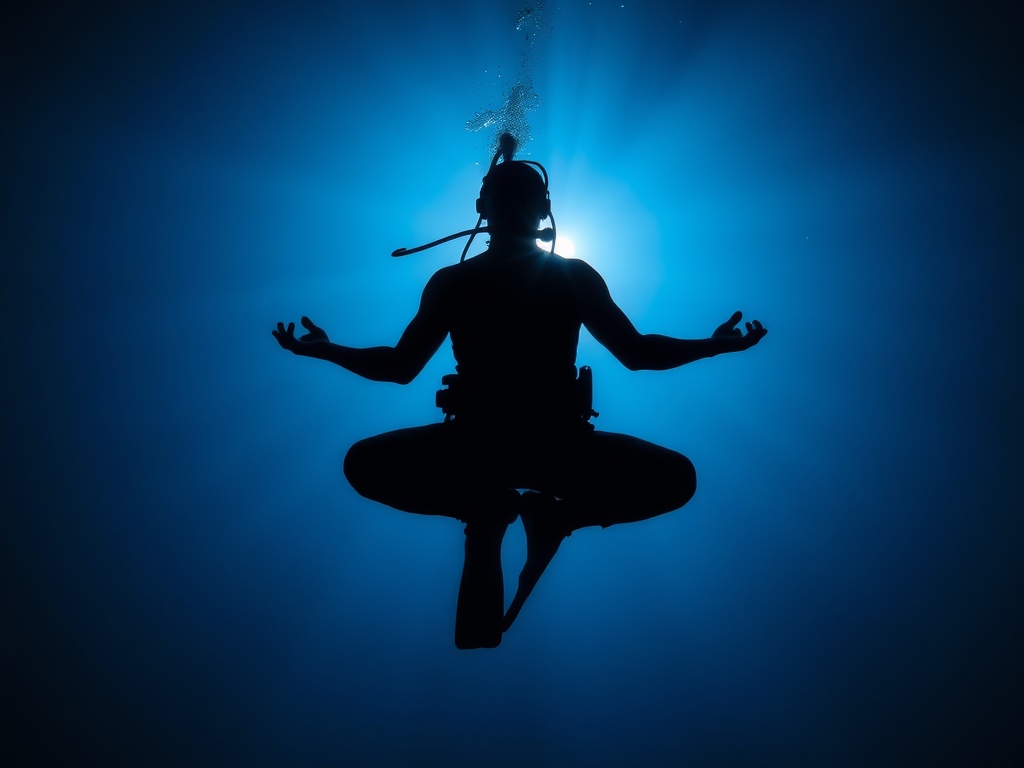
Where to practice this (even if you’re land-locked)
You don’t need the ocean to train this.
In fact, you shouldn’t start there.
Practice the exhale sequence on dry land:
- Before a CO2 table
- While lying on your back, one hand on the belly
- During slow breathwork sessions in the morning
The goal is consistency. The nervous system learns through repetition, not intensity.
By the time you bring this into the water, it should feel automatic... like blinking.

The deeper layer
This isn’t just about performance.
It’s about trust.
When you finish your exhale completely, you’re practicing letting go of control in a measurable, physical way. You’re telling the body: we don’t need to cling to this breath—we can release it and still be okay.
That mindset carries into the descent.
Because at depth, everything tightens unless you choose otherwise.
The diver who can release... goes deeper.

Common errors to watch for
- Forcing the exhale aggressively (creates tension instead of removing it)
- Skipping the pause after the exhale
- Inhaling too quickly immediately after
- Carrying shoulder tension into the final breath
Slow it down. The ocean isn’t going anywhere.
The calibration
Next time you’re on the line, don’t think about your depth.
Don’t think about your time.
Focus on that one exhale.
Make it complete. Make it honest.
The rest of the dive will follow.
...and when it does, you’ll feel it—not as effort, but as absence of resistance.
Breathe easy, dive safe.