The Dark Descent: What Night Freediving Strips Away
The first time I freedived at night, I panicked at eight meters.
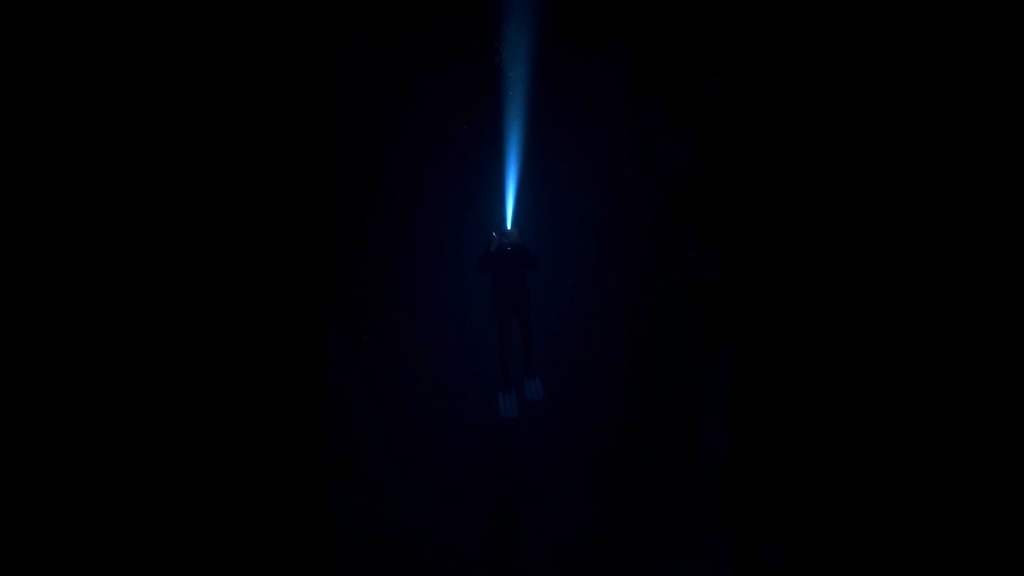
Not because anything went wrong. Because nothing was there. No reef. No bottom. No visual reference at all. Just the beam of my buddy's light cutting a cone of particles through black water, and the sound of my own heartbeat getting louder as the dark pressed in.
I turned around. Ascended. Sat on the boat for twenty minutes. Then I went back down.
That was six years ago. Night freediving is now the thing I look forward to most in Kona. It rewired how I think about depth, trust, and the body's relationship to information.
Why Darkness Changes Everything
During a daytime dive, your eyes do enormous amounts of work you never notice. They orient you. They confirm depth. They give your brain continuous evidence that you're moving through space in a direction that makes sense.
Remove that, and your nervous system has to renegotiate its entire contract with reality.
Here's what actually happens in the first thirty seconds of a night descent:
- Your proprioception sharpens. Without visual anchors, your body starts paying closer attention to pressure changes on your eardrums, the compression of your wetsuit, the angle of your fins.
- Your Mammalian Dive Reflex often kicks in faster. I don't have peer-reviewed data on this — just years of noticing that my heart rate drops more aggressively when I can't see the bottom. My theory: the brain reads darkness as "deep water" and frontloads the bradycardia response.
- Your CO₂ tolerance feels different. Not worse, not better — different. The psychological weight of darkness amplifies the contraction signal. What you'd ride through at thirty meters in daylight can feel urgent at fifteen meters in the dark.
This is not a failure of nerve. It's your brain doing exactly what evolution designed it to do: treating sensory deprivation as a threat multiplier.
The Darkness Isn't Empty. You Are.
I tell my students something that sounds contradictory: night freediving is both more dangerous and more meditative than daytime diving.
More dangerous because you lose visual confirmation of orientation, buddy position, and surface distance. A disoriented freediver at depth in the dark is a rescue scenario waiting to happen.
More meditative because once you stop fighting the absence of input, you drop into a sensory state that daytime diving can't touch. The Great Quiet gets quieter. There's a bandwidth that opens up when your visual cortex stops processing reef fish and particulate matter. You feel the water differently. You feel yourself differently.
Some of my deepest relaxation on a single breath has happened at night, at modest depth, in the waters off Puakō.
But you don't get to that state by accident. You get there by protocol.
My Night Freediving Protocol
I don't teach night freediving to students who haven't logged at least fifty daytime dives and demonstrated solid buddy protocol. If your surface protocol is sloppy in daylight, darkness will expose it immediately.
Here's what my night sessions look like:
1. Lights and Redundancy
Every diver carries two lights. Primary on a lanyard, backup clipped to the weight belt. I use a narrow-beam primary for orientation and a low-lumen backup that stays off unless the primary fails. Flood lights are for scuba photographers — they ruin your night adaptation and illuminate so much particulate that you might as well be diving in milk.
The line gets a cyalume stick at the surface float and another at ten meters. That's your vertical reference. Without it, you're guessing.
2. Depth Caps
I cut daytime target depths by at least 30% for night sessions. If you're comfortable at 30 meters in daylight, your night cap is 20. No negotiation. The physiological demands are similar, but your margin for error on orientation, equalization timing, and buddy visibility shrinks dramatically in the dark.
3. Communication
Light signals replace hand signals. One sweep: "I'm okay." Rapid flash: "Come to me." Light off: emergency. We rehearse these on the surface before anyone gets wet.
I also use a specific pre-dive agreement that I don't bother with during the day: if either diver surfaces and cannot visually confirm the other diver within five seconds, the safety response begins immediately. Not thirty seconds. Not "wait and see." Five seconds.
4. The Breathe-Up
Night breathe-ups take longer. I add two to three minutes to whatever my standard protocol is. Your nervous system needs time to accept the dark, and rushing a breathe-up when your sympathetic system is already elevated is a recipe for a short, tense dive.
Float on your back. Let the stars do the work. Kona skies on a clear night are the best breathe-up tool I've ever found.
What the Dark Teaches You
There's a reason I keep coming back to night diving even though it's objectively riskier and logistically harder than a daytime session.
It strips away your crutches.
During the day, most freedivers navigate by sight. They watch the line. They watch the bottom. They use external reference points to manage internal states. "I can see the plate, so I know I'm close" is a way of bypassing the body's own depth awareness.
At night, you have to listen to your body because there's nothing else to listen to. Pressure becomes your depth gauge. The quality of your equalization becomes your altimeter. Your diaphragm contractions become your clock.
Every night dive I've done has made my daytime diving sharper. Not because I got braver. Because I got more internal.
The dark doesn't add anything to the dive. It subtracts everything you were hiding behind.
Who Shouldn't Night Dive
This isn't gatekeeping. It's triage.
If you have unresolved equalization issues — particularly if your Frenzel technique is inconsistent — night diving will make it worse, not better. You need the feedback loop of visual depth reference while you're still building mechanical reliability.
If you have anxiety in open water that you manage by "focusing on something" — the line, the reef, your buddy's fins — night diving removes all of those anchors simultaneously. Work with a coach on your dry-land mental conditioning first.
If your buddy system is casual — "yeah, we dive together, sort of" — stay out of the dark water until it's airtight. Night diving without rigorous buddy protocol is the single fastest way to turn a recreational dive into a body recovery.
I don't say that to scare anyone. I say it because I've been the safety diver on calls that started with "we were just doing a quick night dive."
The Payoff
Last month, I did a 25-meter night dive off the Kona coast. No current. No moon. Water temperature around 25°C. My buddy held station at ten meters with a single red-filtered light pointed down.
At depth, I killed my primary light for about fifteen seconds.
Bioluminescence. Everywhere. The kind you can't see when your torch is on. Green sparks trailing off my fins. A faint glow along the thermocline. The ocean doing what it does when you stop blasting photons at it.
That's the trade. You give up control, you give up sight, you give up the comfort of knowing exactly where you are — and the ocean gives you something back that it doesn't show to people who need the lights on.
Breathe easy. Dive dark.