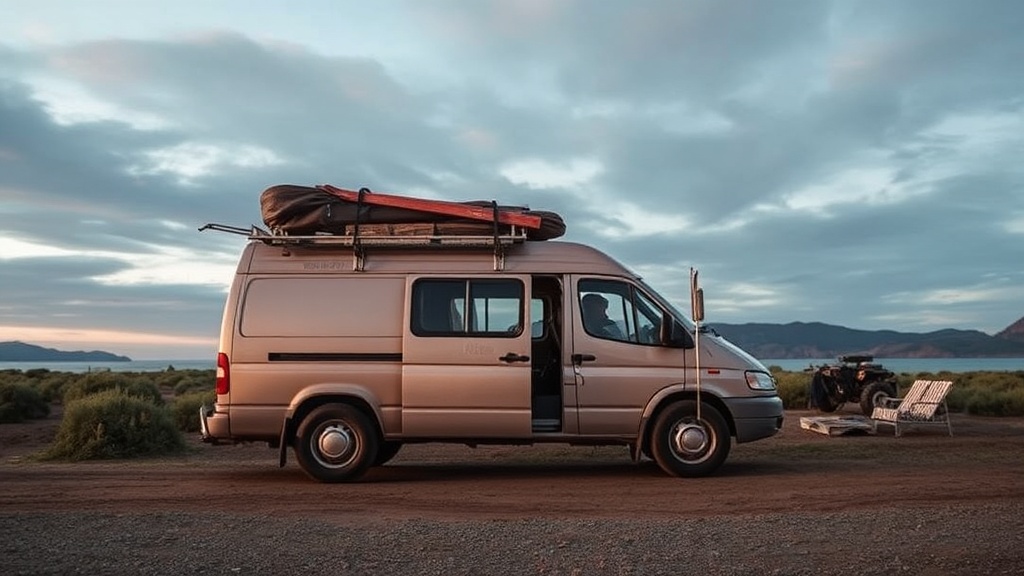
Planning a Month-Long Freediving Expedition from Your Van
What does it actually take to string together thirty days of meaningful dives from the driver's seat?
That's the question that keeps surfacing in my inbox lately. There's a particular hunger I've noticed among intermediate freedivers—the ones who've outgrown their local quarries and weekend boat charters, who've started daydreaming about salt-crusted windshields and pre-dawn entries at spots they've only seen in blurry underwater footage. They want to know how to transform a recreational hobby into a mobile pursuit. How to trade the chlorine and pool walls for open coastlines and the particular rhythm of waking up, checking swell forecasts, and sliding into water that changes daily.
Planning a month-long expedition isn't about accumulating as many dives as possible. It's about learning to read a coastline like you'd read your own breath hold—patiently, with attention to what shifts beneath the surface. The logistics matter. Where you park affects your sleep quality, which affects your equalization, which affects whether you hit that personal best you've been chasing. Everything connects.
Which Coastal Routes Offer the Most Reliable Conditions for Extended Trips?
Not all shorelines play nice with the van-life approach. Some coasts—think Northern California's Big Sur or Oregon's Highway 101—deliver world-class visibility and dramatic topography, but they're also moody. Fog rolls in for weeks. Swell windows close. If you're committing to a month on the road, you need contingency plans built into the geography itself.
The Hawaiian Islands remain my baseline recommendation for first-timers, not because they're easy (they're not), but because conditions are trackable and the infrastructure exists to support mistakes. NOAA's coastal data provides remarkably granular swell and wind forecasts for the archipelago, and the inter-island ferry system (where it operates) means you can adjust your route without burning through your entire fuel budget on a single crossing.
That said, the Eastern Pacific corridor—from Baja's Cabo Pulmo up through mainland Mexico's Pacific pockets—offers something Hawaii cannot: variability within driving distance. You can chase sardine runs in the morning and be decompressing in hot springs by afternoon. The trade-off is infrastructure. Water fills become calculations. Beach entries require reconnaissance. But for divers who've developed some comfort with uncertainty, this stretch rewards flexibility in ways that scheduled resort diving never could.
How Do You Balance Diving Load With Recovery While Living in a Vehicle?
This is where theory crashes into the reality of 65 square feet of living space. In a stationary diving life—pool training, weekend boat trips—you have recovery infrastructure. Ice baths. Proper beds. Dark rooms for napping between sessions.
In a van, recovery becomes active work.
I've developed a protocol over three years of coastal living that treats the vehicle itself as part of the training apparatus. Thermal management matters more than most divers anticipate. After deep dives, your body needs to rewarm efficiently, which means parking strategies that maximize sun exposure during afternoon surface intervals. It means investing in a proper camp shower—not for luxury, but for thermoregulation. Rinsing salt off immediately after dives isn't about comfort; it's about keeping your peripheral vasoconstriction response sharp for the next session.
Sleep positioning becomes surprisingly technical. Van mattresses are rarely optimal for the particular lower-back strain that deep freediving produces. I've found that elevating my legs slightly—using a dry bag filled with spare wetsuits—reduces the inflammation that accumulates after repetitive deep equalization. Small adjustments compound over thirty days.
The psychological recovery piece is harder to engineer. When your bedroom faces the ocean, there's a temptation to never stop looking, never stop checking conditions. I use a simple rule: no dive planning after sunset. The laptop closes. The forecast checks cease. This boundary—arbitrary but inviolable—preserves the mental freshness that deep diving demands.
What Gear Configurations Actually Work for Mobile Diving Operations?
Every freediver starts their van build with grand ambitions. Custom fin racks. Built-in neoprene drying cabinets. UV water purification systems. Within a month, most of this gets stripped out.
The most reliable configuration I've found is modular and ruthless. You need three zones: wet, drying, and sacred. The wet zone lives outside—literally. A cargo box or rear drawer system that never enters your living space. Salt water destroys van conversions faster than almost anything except mold. The drying zone is transitional—lines for wetsuits, mesh bags for masks and computers, positioned where airflow moves but where spray won't reach your bedding.
The sacred zone is non-negotiable. It's where you sleep, where you meditate, where you review dive footage and log depths. No neoprene enters. No tank gear migrates. Violate this boundary and you spend your month in damp sheets, fighting respiratory infections that end expeditions prematurely.
For long trips, I carry three wetsuits in rotation—not for temperature variety, but for drying cycles. A 3mm suit takes roughly eight hours to dry completely in humid coastal air. With three suits, you can dive daily without ever pulling on damp rubber. This sounds excessive until you've experienced the particular misery of a dawn entry in a wetsuit that's been wet for three days.
My computer setup runs on a simple principle: redundancy without weight. Primary computer on the wrist, backup depth gauge in the dry bag, manual tables written on waterproof paper as tertiary reference. DAN's incident statistics consistently show that equipment failure—especially computer malfunction—ranks among the top contributing factors in freediving accidents during remote diving. The ocean doesn't care about your minimalist aesthetic.
Where Can You Find Community Without Sacrificing the Solitude That Makes Van Diving Special?
There's a tension in extended dive travel that doesn't get discussed enough. The community aspect—knowing local conditions, having buddies who understand your limits, sharing beta on recent wildlife encounters—is genuinely valuable for safety. But the whole point of the van, for most of us, was escaping the chatter of dive shop culture. The endless gear discussions. The competitive depth talk.
I've found that the most sustainable approach is geographic rather than social. Position yourself near established dive communities without embedding in them. In Hawaii, this means camping up the coast from Kona rather than in Kona itself. You're close enough for emergency support, far enough that your morning session remains yours alone. In Baja, it means timing your presence in Cabo Pulmo for the shoulder seasons—September and May—when local divers are present but tourists have thinned.
Online communities serve a different function for mobile divers than for stationary ones. The Freedive-Earth forums maintain remarkably detailed location-specific threads where van divers share real-time condition reports, camp spot recommendations, and—critically—information about water fill stations and local regulations that change seasonally. These asynchronous connections provide community benefits without requiring the social energy that extended trips deplete.
The deepest dives I've experienced during van expeditions came not from pushing depth tables, but from the particular mental state that develops around day twelve of coastal living. Something shifts when the ocean becomes your neighborhood rather than your destination. You start noticing patterns—how swell direction affects entry points you've never considered, how tide timing changes local fish behavior, how your own breath capacity responds to sleeping at sea level versus 500 meters up a mountain road. This is the education that multi-day excursions at resorts can't replicate. The body learns differently when the ocean is your commute, your backyard, your constant reference point.
Month-long expeditions reveal what weekend diving conceals: the sport is less about individual dives than about sustained relationship. Learning a stretch of coastline takes time. Learning your own variability—how depth tolerance fluctuates with sleep quality, hydration, emotional state—takes longer. The van forces this education by removing exit strategies. When you're parked at the cliff's edge, the only way through difficulty is forward, into the water, into the practice.