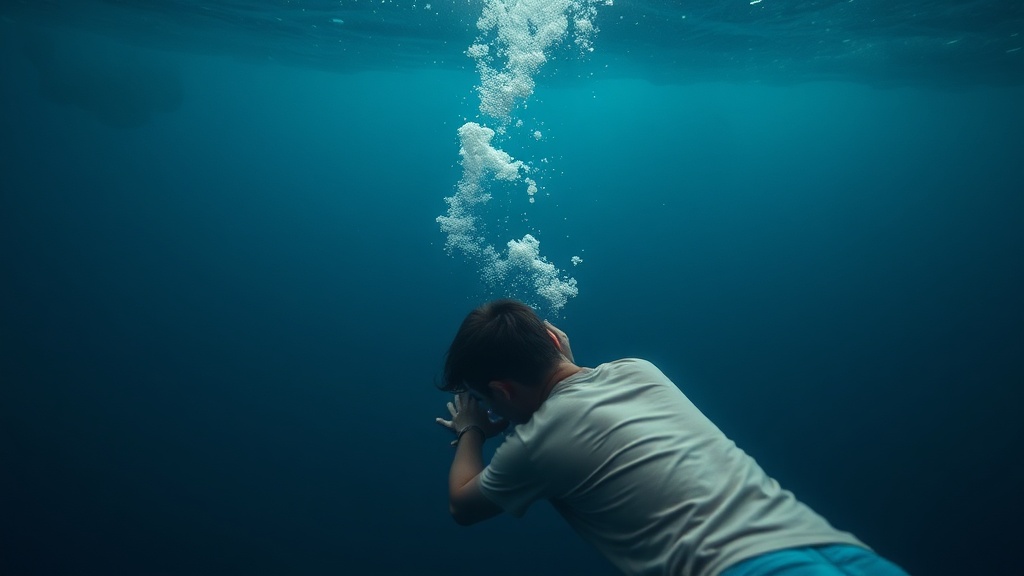
Depth's Quiet Embrace: Adapting to the Ocean's Pressure on a Single Breath
Ever wonder what truly happens to your body when you slip beneath the surface, leaving the sunlit world behind for the profound quiet of the deep? It's more than just holding your breath; it's a fascinating physiological ballet where your system reconfigures itself to thrive in an alien environment. Understanding this dance with pressure isn't just academic; it’s fundamental to becoming a safer, more confident freediver.
What exactly happens to your body when you go deep?
From the moment you duck your head under, your body begins to respond. The most immediate, perceptible change relates to pressure. Boyle's Law is the star here: it states that for a fixed amount of gas at constant temperature, pressure and volume are inversely proportional. In simple terms, as you descend, the surrounding water pressure increases, and any air spaces in your body—your lungs, sinuses, and middle ears—compress. Your lungs, which might hold six liters of air at the surface, could shrink to a mere liter or less at significant depths. This compression is why equalization is so critical: you're actively adding air to these spaces to counteract the squeeze.
But the story doesn't end with air spaces. Your body has incredible, inherent adaptations. The mammalian dive reflex kicks in, a primitive response that prepares you for immersion. One key component is bradycardia, a slowing of the heart rate. Instead of pumping at 60-70 beats per minute, your heart might drop to 40, 30, or even fewer beats per minute for elite divers. This conserves precious oxygen. At the same time, peripheral vasoconstriction directs blood flow away from your extremities (like your arms and legs) and towards your vital organs—your brain and heart. This ensures these critical systems remain well-oxygenated. These two responses work in concert to extend your breath-hold potential.
Then there's the blood shift. As your lungs compress, blood plasma and red blood cells are drawn into the capillaries surrounding your lungs. This helps prevent lung squeeze or barotrauma by keeping your lung tissues hydrated and structurally sound against the immense external pressure. It's a remarkable example of nature's engineering, allowing us to safely explore depths that would otherwise be impossible.
How can you make equalization easier as you go deeper?
Equalizing your ears and sinuses is arguably the biggest hurdle for new freedivers. Many start with the Valsalva maneuver (pinching your nose and blowing), which is fine for snorkeling but quickly becomes inefficient and potentially dangerous at depth. Why? Because it uses your diaphragm, which is already working against the increasing pressure. You're effectively trying to push air from a compressing space (your lungs) into another compressing space (your ears)—it’s like trying to inflate a balloon underwater using another smaller, deflating balloon. It requires more effort and can lead to a 'reverse block' on ascent if you force it too hard.
For comfortable, deeper diving, we need smarter techniques. The Frenzel maneuver is the first big leap. Instead of using your diaphragm, Frenzel uses your tongue and cheek muscles to 'pump' a small amount of air from your mouth cavity into your Eustachian tubes. This is far more efficient because it works with minimal lung volume and doesn't engage your diaphragm. It's a skill that takes practice, but once you get it, it becomes second nature.
Beyond Frenzel, for those pushing extreme depths, the Mouthfill technique becomes indispensable. As you descend past residual lung volume, there's simply not enough air left in your lungs to even perform a Frenzel. Mouthfill involves taking a 'mouthful' of air at a shallower depth (e.g., 10-15 meters) and holding it in your mouth and pharynx, creating a reserve of air that you can then use to equalize your ears all the way down to your maximum depth, using a gentle Frenzel-like action with your tongue. This technique decouples equalization from lung volume, giving you far greater range. It's an advanced skill that requires specific training, often in specialized courses, but it opens up incredible possibilities for deeper, more relaxed diving. Learn more about advanced equalization techniques through reputable organizations like AIDA International, who standardize freediving education globally. (